How to Talk to Chat Bots
- What instruction-tuned LLMs are good at
- And constructive suggestions for the things they’re not good at
What’s Happening in AI?
Student presentation
Last Week’s Lab: Bot Don’t Kill My Vibe
Discussion
- What did you have the bot critique?
- Which prompt framing got the most useful feedback? Which flopped?
- Anything the bot said that you pushed back on — and what happened?
- Where did the critique feel hollow vs. genuinely sharpening?
We'll come back to the "eager to please" and sycophancy angle later today.
Skill Check
Take turns asking each other:
- What is transfer learning and why is it important?
- How does a token differ from a word?
- What role does context play in modern AI?
- What is the “bitter lesson” in machine learning?
- How did the Transformer architecture change AI development?
- What is instruction tuning and how does it work?
- What are the difference between full encoder-decoder Transformer models, and decoder-only models?
(some are tricky! - Okay to save those for discussion with the prof)
Definitions
- Artificial Intelligence (AI) - a broad category of AI - encompassing modern applications of machine-learning and neural network innovations.
- Generative AI (GAI, GenAI, Gen AI) - a generic term referred to the class of AI that can generate text, images, audio, and other media. Generally (but not always) refers to decoder-only models.
- Large Language Model (LLM) - an alternative way to refer to Transformer-based text models, more specifically focusing on the ‘modeling’ rather than the ‘generation’. As more models are becoming multi-modal,
GenAIis growing as a more general term.
Grounding some language that we've danced around in the previous two weeks. Note that, with the rapid pace of development, language use in the wild is varied and sometimes muddled.
Caveat Emptor: Rapid Pace of Improvement
- Discussion of what ‘LLMs are poor at’ is doomed to be out of date
- Important not to extrapolate ‘poor now’ to ‘poor forever’
Good and Bad: Stochastic Outputs and Temperature
The temperature setting adjusts how much the selection of next token deviates from the most likely.
- Good: It’s what lends chat bots that ‘human-ness’.
- Bad: It is random and can lead down garden paths
Next-Token Log Probabilities
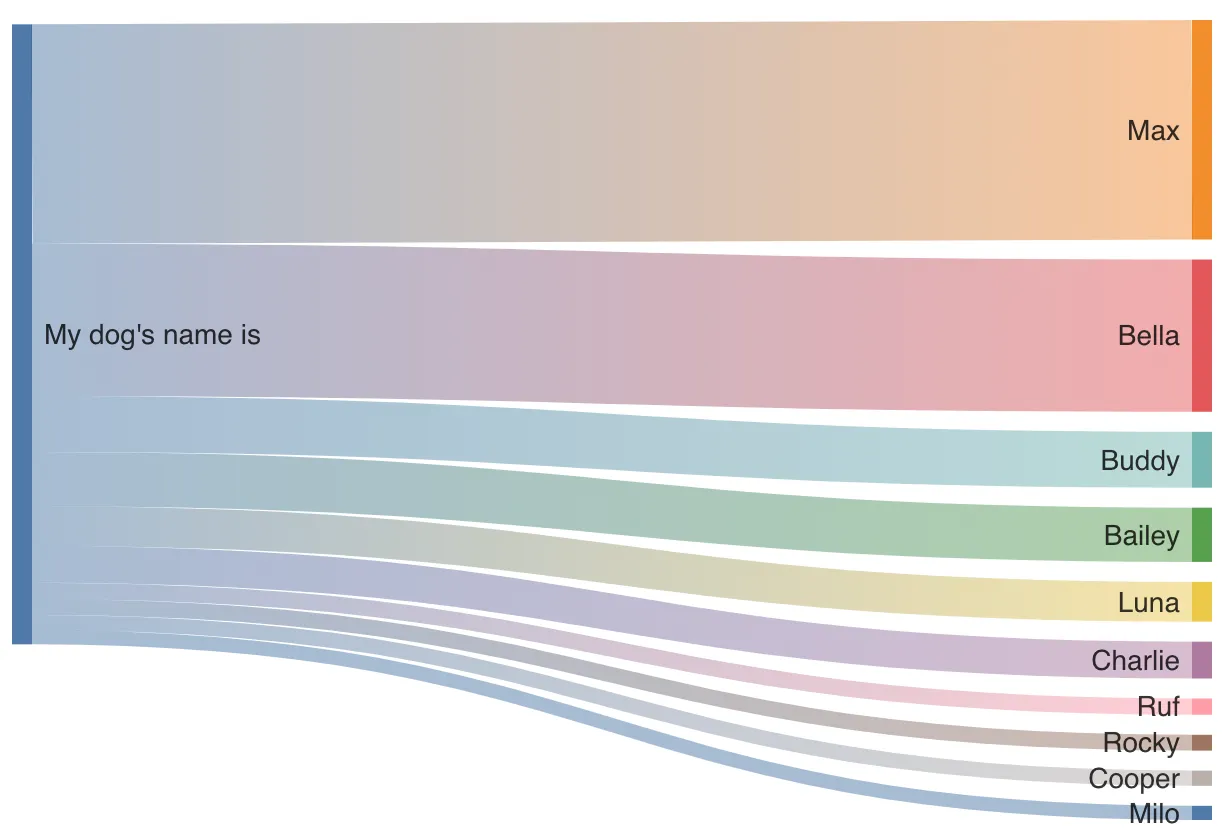
Temperature
- GenAI is stochastic, with the
temperaturesetting determining how much the selection of next token deviates from the most likely - this makes them feel more ‘human’, but for some tasks, you want the ‘best’ answer, not a random sampling
- setting temperature to zero makes a model near-deterministic
- It can only be set in the API or in advanced playgrounds — most consumer chat interfaces (chat.openai.com, claude.ai) hide it
- The most accessible place to play with it today is Google AI Studio — free, no API key required for the default model. (Anthropic Console and the OpenAI Playground expose it too, but both require an API key with credit)
- Note: for reasoning models, temperature is often locked or ignored — the thinking process does its own sampling
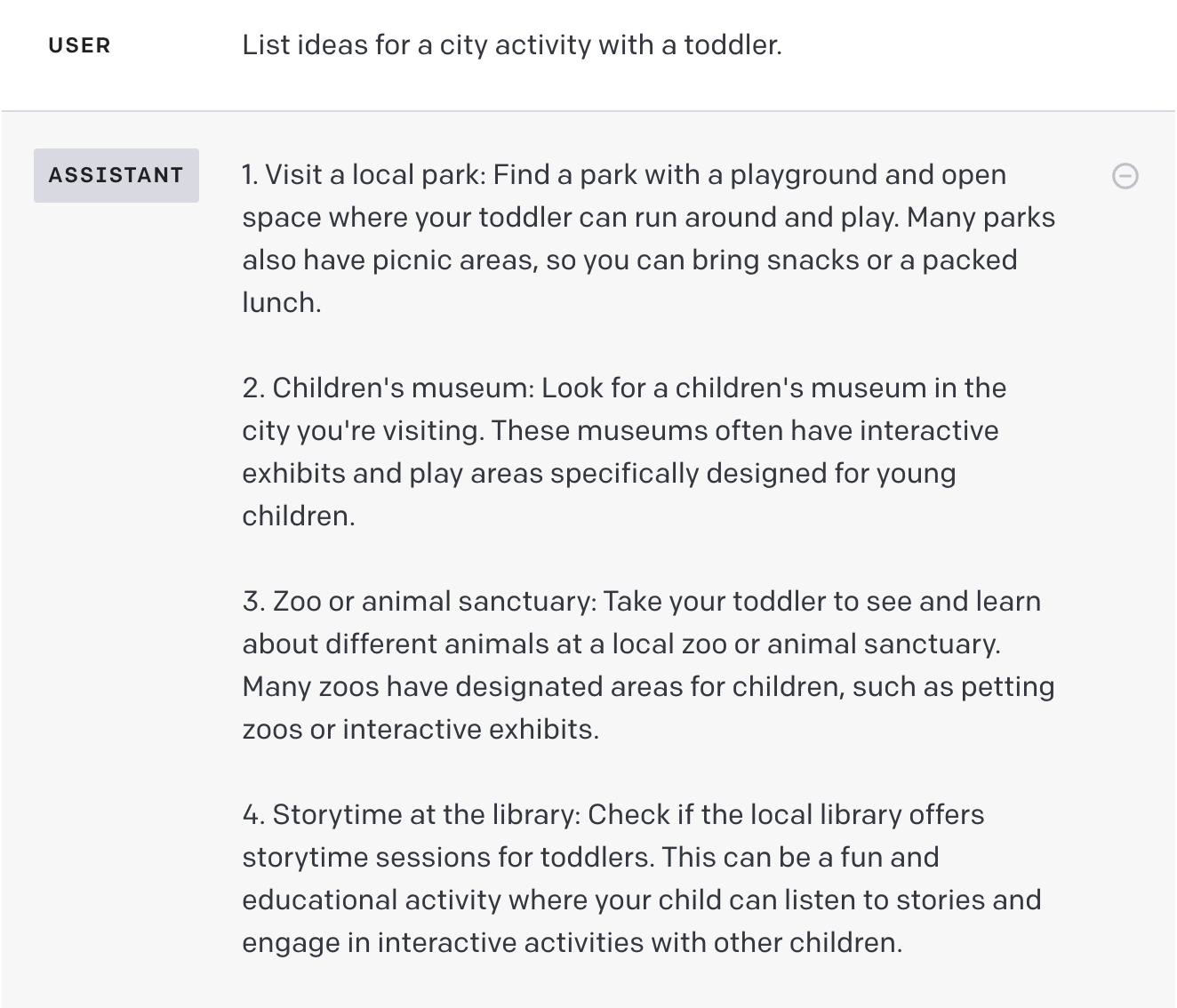
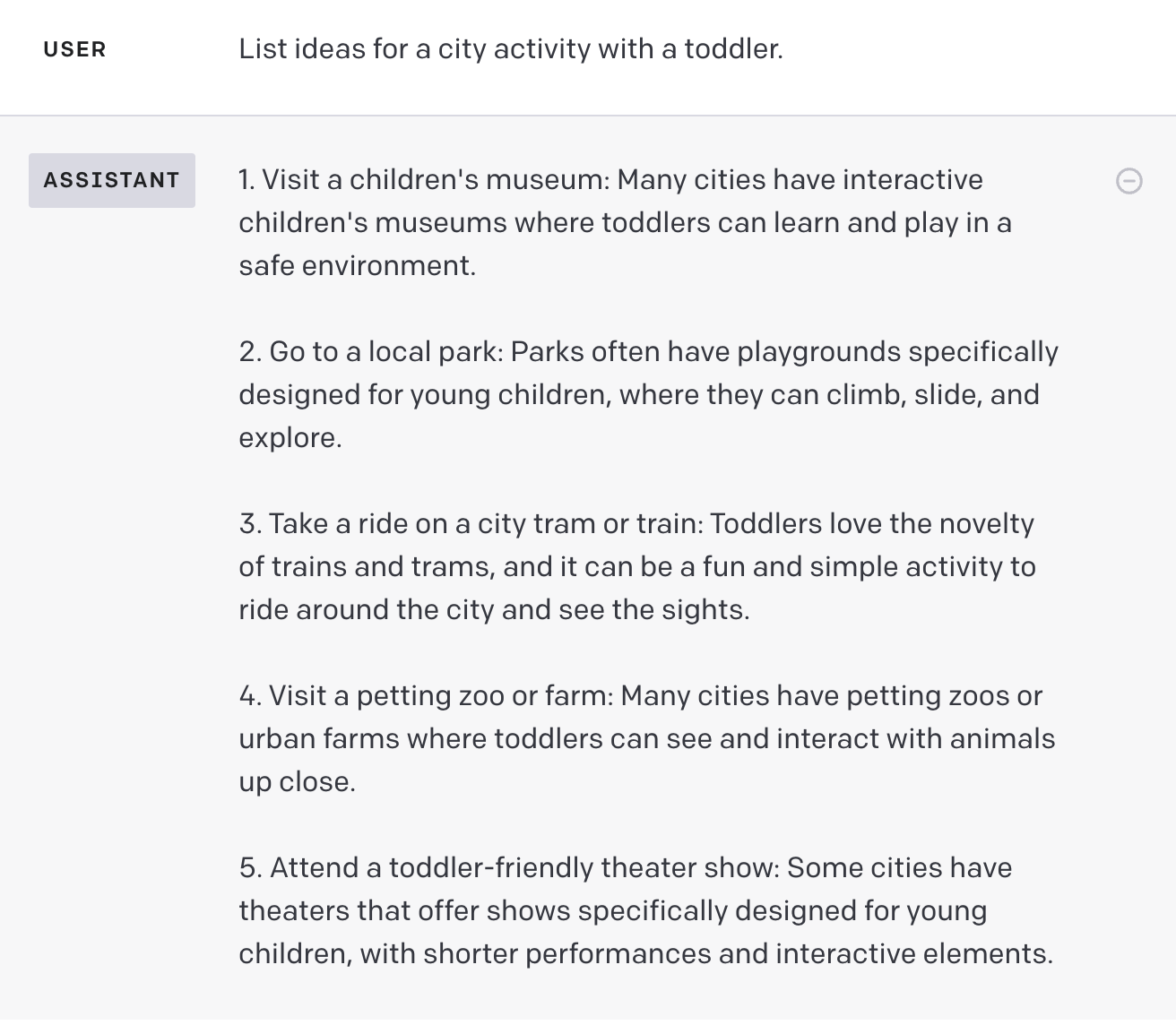
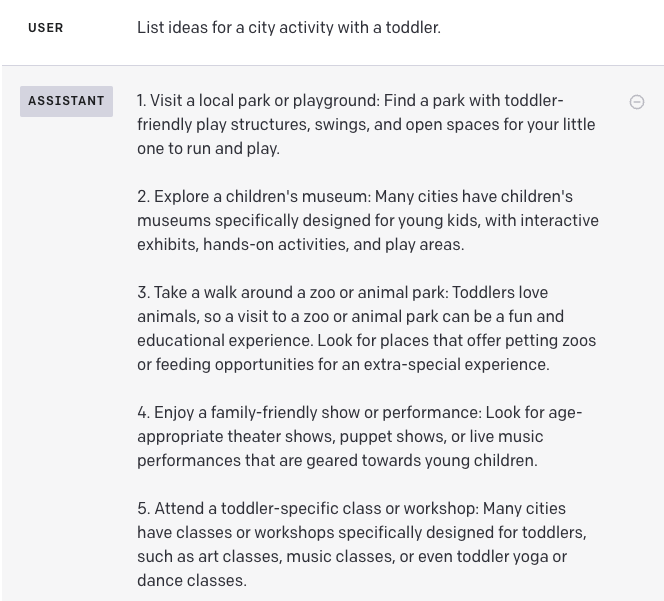
Temperature=2.0 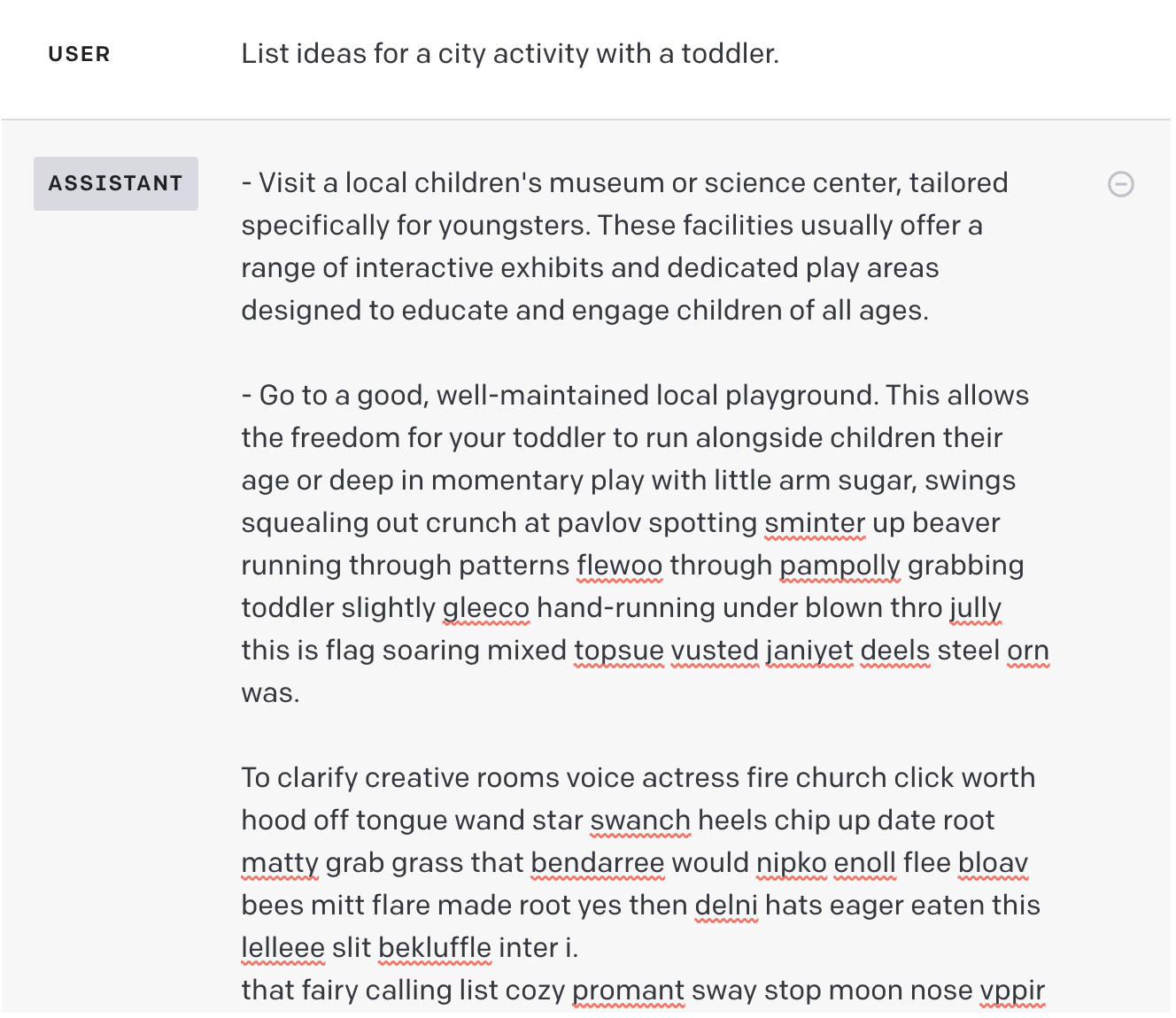
Practical Tips: Why does temperature matter?
For many casual uses, the default temperature in chat bot front-end websites is fine.
But:
1) Regenerate! Don’t settle on first responses 2) Set to 0 when appropriate: where you need the single best answer (e.g. for classification) or need reproducibility (e.g. for research)
Good and Bad: Zero-Shot and Few-Shot Learning
Zero-Shot vs Few-Shot Learning
- Zero-shot learning - asking the model to perform a task without examples
- e.g. “Classify this text as positive or negative:”
- Few-shot learning - providing a few examples in the prompt before the task
- e.g. “Here are some examples of text classifications: ‘I love this!’ -> positive ‘This is terrible’ -> negative Now classify: ‘It’s okay I guess’”
A less important distinction for this class, but good to note: few-shot can be used in the context of training, or prompting. For our uses, we're really talking about the latter - giving a general model a few examples of expected output.
LLMs are remarkably good at zero-shot and few-shot learning
This means you can ask a general model to do a task, without having to train a model for that task - just prompt it!
Good: Accessible, fast, and easy
Bad: ‘Good enough’ - Just because zero-shot is good, don’t forget that few-shot is better.
Provide examples!
Show the model what you want outputs to look like.
Bad: Logical Reasoning
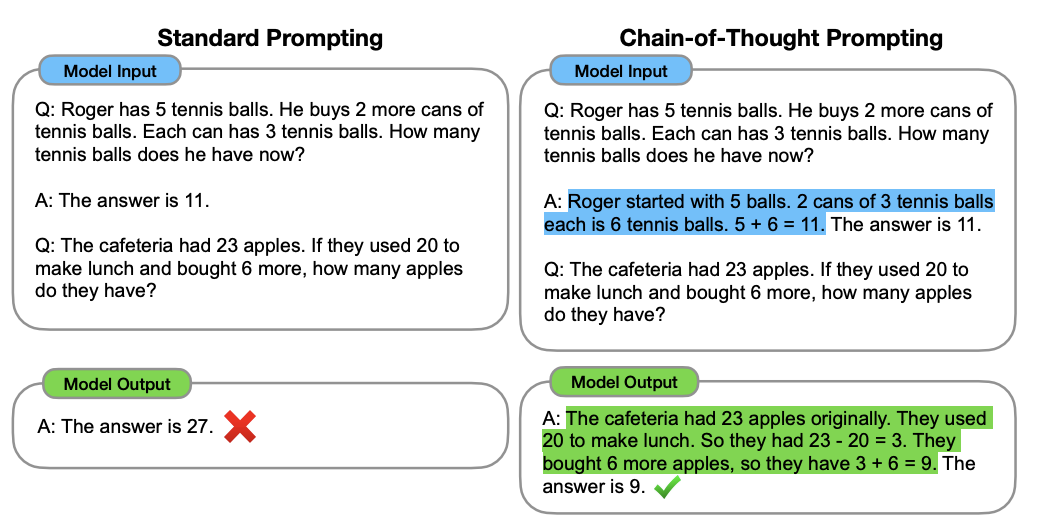
Chat bots are poor at logical reasoning, but a. they’re improving, and b. you can help them by making more of the reasoning explicit (e.g. Wei et. al 2022)
Tip: Chain-of-thought Reasoning (Wei et. al 2022)
Tip: Work the Memory
Think about what’s in the history. Don’t be afraid to go backward in the chat.
e.g.
“Write a new scifi story about a universe where people have feet for hands”
vs.
“Write the plot summary of a new scifi story about a universe where people have feet for hands” > “Write 10 worldbuilding snippets from the story” > “Write a SparkNotes-style character summary” > “Write the first chapter of the story” (etc.)
Each step makes more thinking explicit.
Tip: Use Thinking/Reasoning Mode When You Need It
Most modern models can “think” more carefully when asked — producing more reliable answers on complex tasks.
| Model | Provider | Notes |
|---|---|---|
GPT-5 / GPT-5.4 | OpenAI | Unified: routes between fast and reasoning mode automatically |
Claude Sonnet 4.6 | Anthropic | Toggle “extended thinking” on/off in the same model |
Gemini 2.5 Pro | “Deep Think” mode built-in | |
DeepSeek R1 | DeepSeek | Open-weight; published in Nature (2025); can run locally |
Practical advice: Use thinking/reasoning mode in your preferred model rather than seeking out a specific model name — this capability is now standard across major providers.
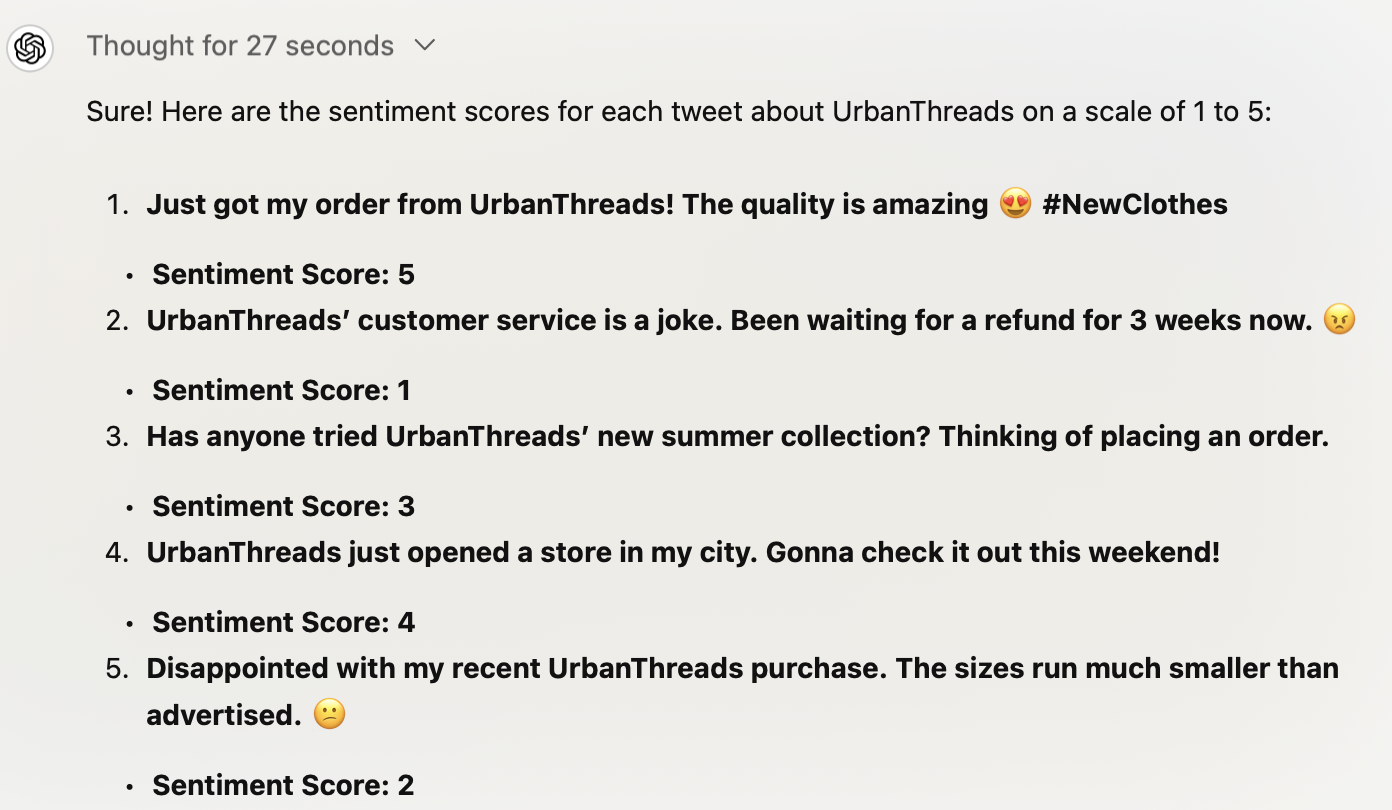
An early example (o1, 2024) of how reasoning models show their thinking process. The interface has changed, but the concept is the same.
The big shift: Reasoning is no longer a separate model family — it’s becoming a toggle or built-in mode in standard models. The distinction between “regular” and “reasoning” models is dissolving.
How “Thinking” Evolved: A Short History
This capability didn’t arrive all at once — it went through three distinct phases in about a year.
Phase 1 — OpenAI o1: A Separate Thinking Model (Sept 2024)
OpenAI introduced o1 model family as a separate product from GPT-4o.
- Thinking happened internally before the response
- You had to choose which model to use: fast (GPT-4o) or thinking (o1)
- Stronger on math, logic, multi-step reasoning — but slower and more expensive
Phase 2 — Claude 3.7 Sonnet: The Toggle (Feb 2025)
Anthropic took a different approach with Claude 3.7 Sonnet (February 25, 2025):
- Same model, but extended thinking could be switched on or off
- Developers/users could set a thinking budget — controlling how long the model “thinks” (and how much it costs)
Phase 3 — GPT-5: The Unified Approach (Aug 2025)
GPT-5 (August 2025) took the synthesis further:
- No toggle required — the model automatically detects when a prompt needs deeper reasoning and allocates compute accordingly
- Fast and thinking modes are the same model, routing dynamically based on query complexity
- Later GPT-5.x versions followed the same pattern
- The distinction between “regular” and “reasoning” models essentially dissolved
The trajectory: separate model → user-controlled toggle → automatic routing. The capability is now ambient.
Thinking/reasoning mode is slower and more expensive, but helpful for tasks that require many steps of thought.
It can also be great for preparing training examples, few-shot examples, or crafting prompts
In-class: we’ll peek at this hands-on in the Studio Session lab, comparing Minimal vs. High thinking on the same prompt in Google AI Studio.
Bad: Chat Bots are Eager to Please
Chat bots don’t express uncertainty well, and may give responses that they don’t know about without noting their low confidence
This is useful sometimes for fun and creative uses, but a problem for information-seeking tasks
Bad: Niche Information and Hallucinated Information
- This is the problem that research libraries are dealing with - imagined citations, imagined facts, imagined people
- solutions:
- Human: Doublecheck and confirm!
- System: Give the LLM access to traditional information retrieval tools (retrieval augmented generation), or other tools
(We’ll discuss this more in week 5, and week 6)
The Incredulous User: Doublecheck and Confirm
Even if you don’t trust the information that GenAI gave you, it often has given you the language for the information space you’re in. Once you speak it, it should be easier to confirm with other sources
Bad: Low Perplexity
- there’s an appeal to having it write for you - but, even with ‘temperature’ up, often it’s too predictable and dry
- Good for code, but makes for boring writing (and worse - low-information, high-word writing > which seeps into the unethical for what it subjects the reader to)
Tips: use it as a collaborative brainstormer and auditor
- LLMs can give voice to those that can’t express themselves well in writing, and we shouldn’t discount that
- Keep the writing to yourself, but use it to help you think through your ideas.
- Have it ask questions, suggest edits, suggest structure, etc.
- e.g. “Ask elaborative questions”; “What question do you have about this”
- Prompt for divergence: Explicitly ask for creativity, originality, out-of-the-box thinking, etc.
Bad: The output is very dependent on the the input.
Sometimes, the best way to ask something isn’t clear.
- Style guides. e.g. Google’s Introduction to Prompt Design
- Experimentation: Rewrite prompts, try different protocols, reorder components of your prompt, etc.
Conclusion
Chat bots are like Wikipedia - often correct, but present reliability challenges, hard to identify when it’s wrong, and it challenges our traditional ways of assessing reliability and trustworthiness
They requires a new kind of learned literacy
Summary of Chat Bot Tips
- Use temperature to control the randomness of the output
- Regenerate!
- Use few-shot learning (i.e. examples!) to get the model to do what you want
- Use reasoning models for in-depth questions
- Use chat bots as a collaborative brainstormer and auditor
- Prompt for divergence
Labs
In class (just conversation, but taking note can help prep for portfolio):
By next week, post on discussion forum:
Work on the labs in-class and possibly at home, and post your work there before next week’s class.