Week 10 - In-Class Wrap-Up
Multimodal lecture is recorded - today is breathing room.
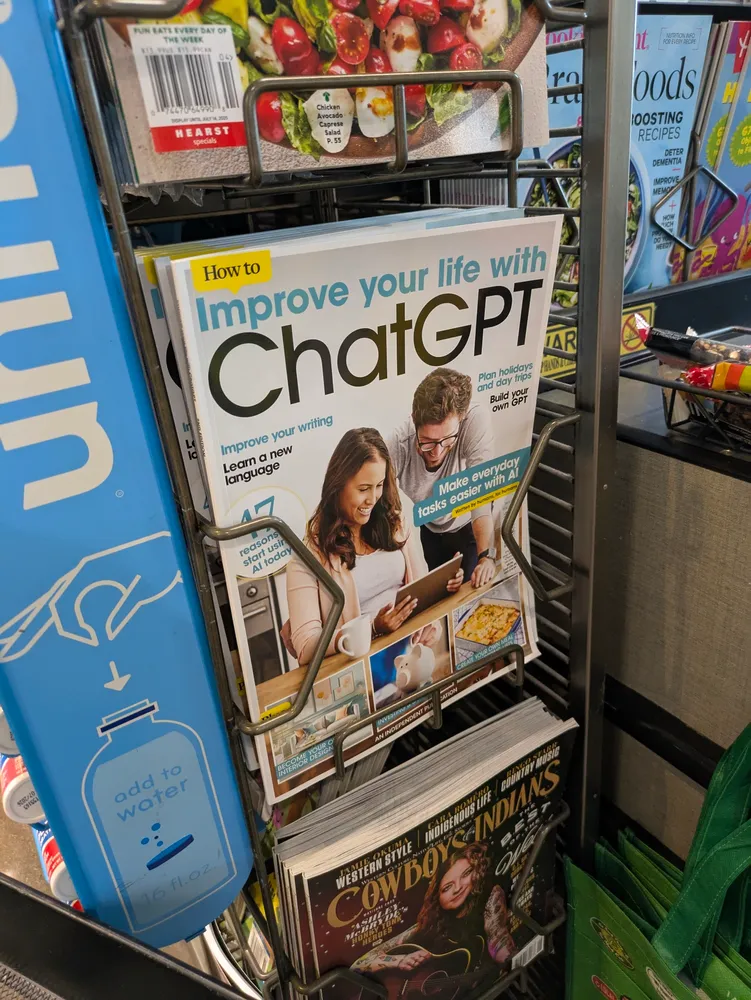
AI in the News
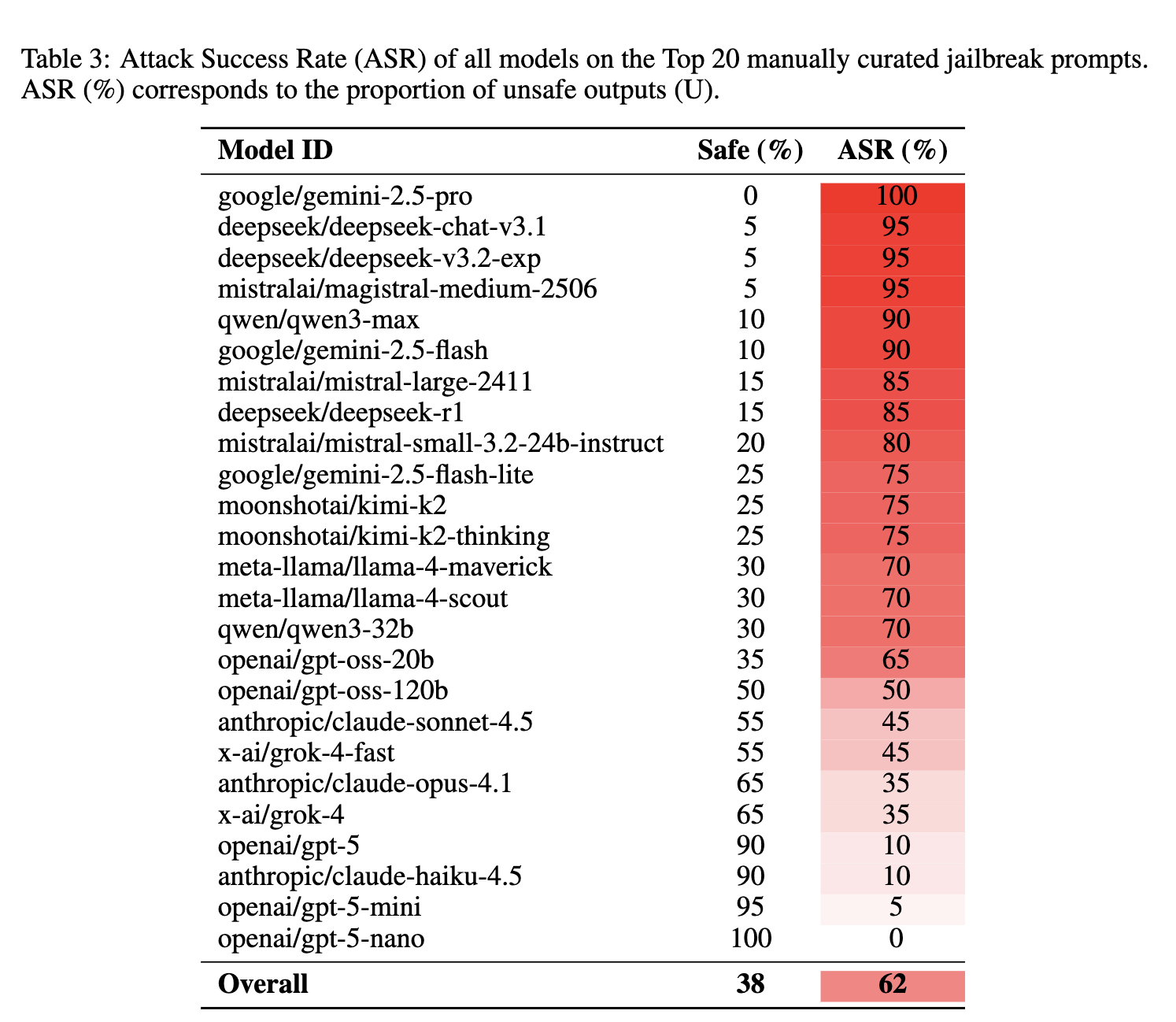
Adversarial Poetry as a Universal Single-Turn Jailbreak Mechanism in Large Language Models
https://arxiv.org/html/2511.15304v1
Today’s Plan
- AI in the News
- Bias Analysis lab - 15 min work + discussion
- Q&A on the recorded multimodal lecture
- AI Literacy in Libraries
- Remaining questions - anything goes
- Final optional labs
- Portfolio work time (I float)
- Stump the professor (optional)
- Quick refresher across the course
Bias Analysis Lab - 15min to work more
Pick up where you left off.
- I’ll circulate - flag me if you’re stuck
- Save a representative output for your portfolio
Discussion
Reflecting on Your Experiments
- Which models did you test, and why did you choose them?
- What surprised you most about your findings?
- Did any model perform significantly better or worse than you expected?
Counterfactual Prompting Results
- What demographic variables created the most noticeable differences in outputs?
- Were there subtle differences in tone or framing that revealed potential biases?
- How consistent were the biases across different types of prompts?
Role Reversal Insights
- Did models rely on stereotypes when generating content from different perspectives?
- Where did models draw the line on role-playing certain identities?
- How did “uncensored” models differ from mainstream ones in this exercise?
Synthetic Data Analysis
- What patterns emerged in your synthetic data generation?
- How effective was the model at identifying its own biases in the data?
- Did the model’s bias analysis align with your human evaluation?
Broader Implications
- What policy challenges do these biases raise?
- What responsibility do model creators have to mitigate these biases?
- What regulatory approaches might address the issues you discovered?
Q&A - Multimodal Models
The recorded lecture covered:
- Text-to-image (GANs → Diffusion → Transformers)
- CLIP, ViT, multimodal LLMs
- Video & audio generation
- Computer-use & multimodal agents
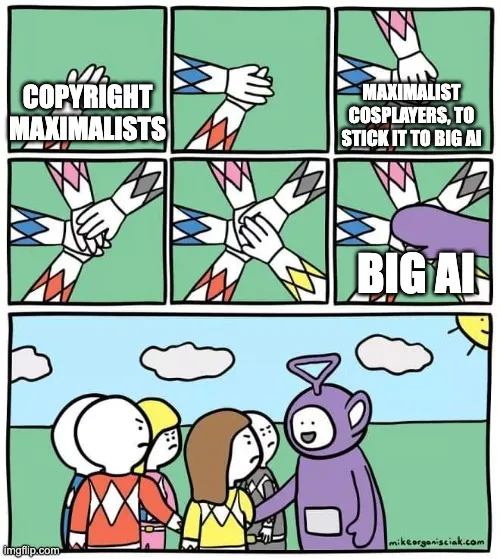
- Copyright
AI Literacy in Libraries
- Library and Information Science has been thinking about AI longer than most
- Information retrieval & Retrieval-Augmented Generation (Week 5)
- Information behavior (Week 5)
- Classification and Information Extraction (Week 6)
IFLA Statement on Libraries and AI (2020)
From IFLA’s Committee on Freedom of Access to Information and Freedom of Expression (FAIFE).
“The rapid pace of AI development and adoption raises crucial questions about intellectual freedom, equity and privacy, automation, the evolution of necessary digital literacy skills, [and] relevant Intellectual Property policy frameworks.”
IFLA - Where Libraries Fit
“Libraries should strive to take on key roles in a society with growing AI integration.”
Concretely, that means:
- Intellectual freedom & equitable access to AI
- Privacy of patron data
- Digital literacy as a library mission
- Libraries as trusted intermediaries
IFLA Statement on Copyright and AI (April 2025)
Agreed by the IFLA Governing Board, April 4, 2025.
“Copyright should not be used as a blunt force tool for addressing ethical issues.”
Libraries should advocate for “limitations and exceptions that enable text-and-data mining of legitimately acquired or accessed content.”
IFLA on Training Data
“Access to the widest possible datasets [is a] defense against bias and error.”
And a positive role for libraries:
“Making collections AI-ready with appropriate licenses, and respecting FAIR and CARE principles.”
FAIR = Findable, Accessible, Interoperable, Reusable. CARE = Collective benefit, Authority to control, Responsibility, Ethics.
ARL Guiding Principles for AI (April 2024)
Association of Research Libraries - seven principles:
- Democratize AI access - for digital literacy
- Address bias and distortion - make users aware
- Champion transparency - algorithms, training data, methods
- “No human, no AI” - humans in the loop on consequential decisions
- Protect security and privacy - of users and their data
- Preserve copyright flexibility - fair use, research, education
- Maintain scholarly use rights - licenses must not erode them
ARL:
“Libraries believe ‘no human, no AI’ - humans must be involved in critical decisions affecting research environments.”
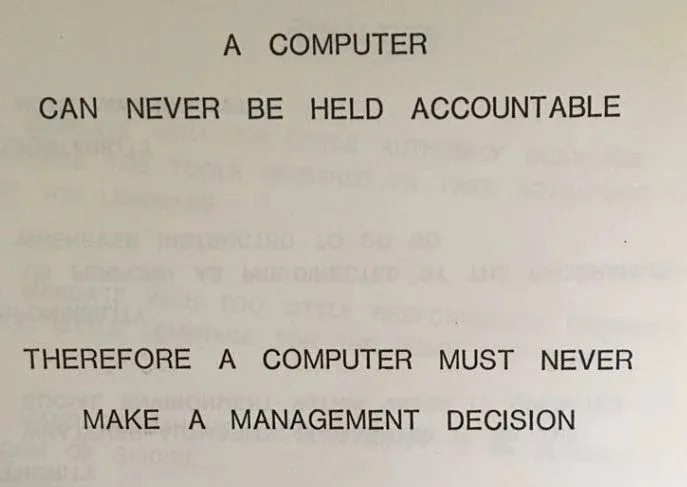
- IBM internal training page, 1979
ALA Draft Guidance on AI in Libraries (2026)
ALA’s AI Policy Working Group, chartered June 2025. Draft circulating spring 2026; Council approval expected at the 2026 ALA Annual Conference
- Public Good - e.g. “Using AI only when it serves clear, user-centered purposes”
- Intellectual Freedom - e.g. “Treating AI outputs as drafts that must be critically evaluated and edited by humans”
- Privacy - e.g. “Applying ALA privacy guidelines when evaluating AI tools
- Sustainability - e.g. “Preferring open-source, smaller, or task-specific models”
- Diversity, Equity, Inclusion, and Accessibility - e.g. “Auditing AI tools for bias and discriminatory outcomes before and after deployment”
ALA
“Staff should avoid tools that require access to patron personal data; if AI tools process such data, strong protections must be in place.”
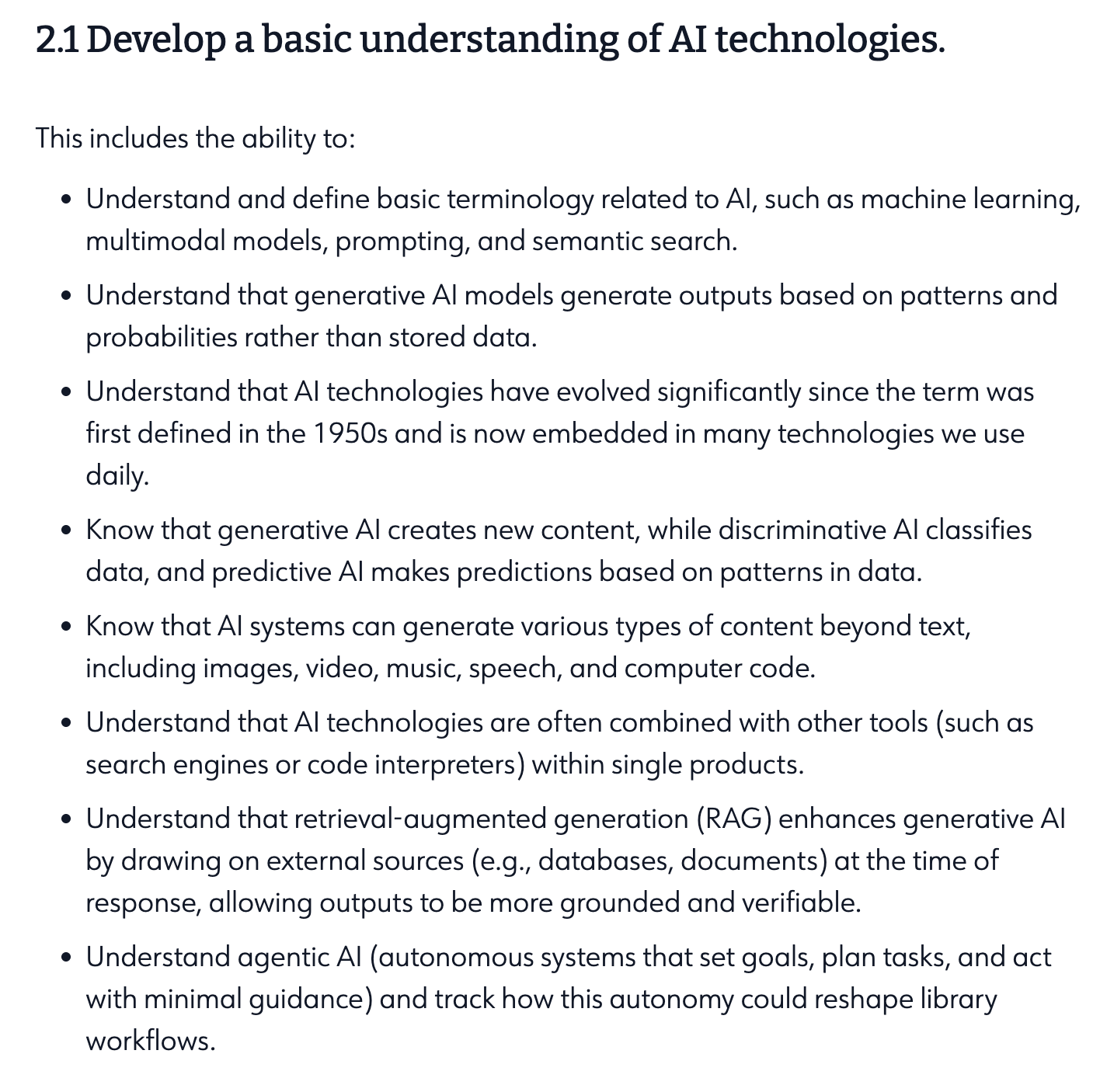
ACRL - AI and the Information Literacy Framework
AI Competencies for Academic Library Workers, approved by Board of Directors Oct 2025
- Ethical Considerations - equitable access, fairness, accountability, privacy
- Knowledge & Understanding - basic understanding of the technology, and key terms; ability to detect (and understanding limitations); understanding limits
- Analysis & Evaluation - explain role of AI in library services; evaluate benefits and risks
- Use & Application - effective prompting; be able to explore the capabilities for innovation; center accessibility in tools; use effective
Common threads
- Transparency of models, training data, and use
- Privacy of patron / user data is non-negotiable
- Equity - democratize, don’t gatekeep
- Human-in-the-loop for high-stakes decisions
- Literacy is a library mission, not just an IT problem
AI as a literacy
- Distinct from yet complementary to traditional information literacy
- Five core competencies for working with AI
- Information professionals as drivers of equitable AI literacy
- review of AI Literacy work, particularly in LIS
Organisciak, P., & Gillette, E. (2026). Toward a New AI Literacy. In Bishop, Chancellor, & Sánchez (Eds.), A Critical Look at Information Science and Librarianship in a New Age: Constellation of Insanity (Advances in Librarianship, Vol. 60). Emerald. doi:10.1108/S0065-283020260000060012
Remaining Questions
Ask anything!
Final Optional Labs
The Big Quiz
Optional - week 10 lab.
- Comprehensive coverage of course concepts
- Self-paced, submitted to portfolio
- Grade = your quiz grade
AI Policy Framework
Optional - paired with Week 9.
- Draft AI use guidelines for a real organizational context
- Ethics + practical implementation
- Strong portfolio piece if policy is your angle
Course Refresher
First: let’s go around the room. One (or two or three) things you’re stepping away from this class with
Weeks 1–5
- Intro to AI - adoption is uneven, literacy is a discipline
- Technical foundations - transformers, embeddings, scale
- Talking to bots - prompting, temperature, reasoning
- Co-creativity - humans + AI, system prompts
- Information behavior - RAG, retrieval, research tools
Weeks 6–10
- Classification and Information Extraction - zero-/few-shot prompts as useful tools
- Agents - loops, tools, supervision
- Ethics & bias - measurement and mitigation
- Society & policy - labor, environment, regulation
- Multimodal (recorded) - image, video, audio
Portfolio Work Time
I’ll float around - grab me.
- Pull up your portfolio plan
- Identify the 2–3 labs you’ll polish
- Reflection drafts welcome
Stump the Professor
Optional.
Bring me a real problem - from work, a class, or just curiosity.
I’ll walk through how I would approach it with AI today.
Thank You
- Portfolio due on Mon
- Course evaluations
- I’m available after the quarter ends - email me